
My Approach to
Communications
Strategy
Three moves: channel clarity, following the signal, and full extraction.
Two real programs below show it in practice.
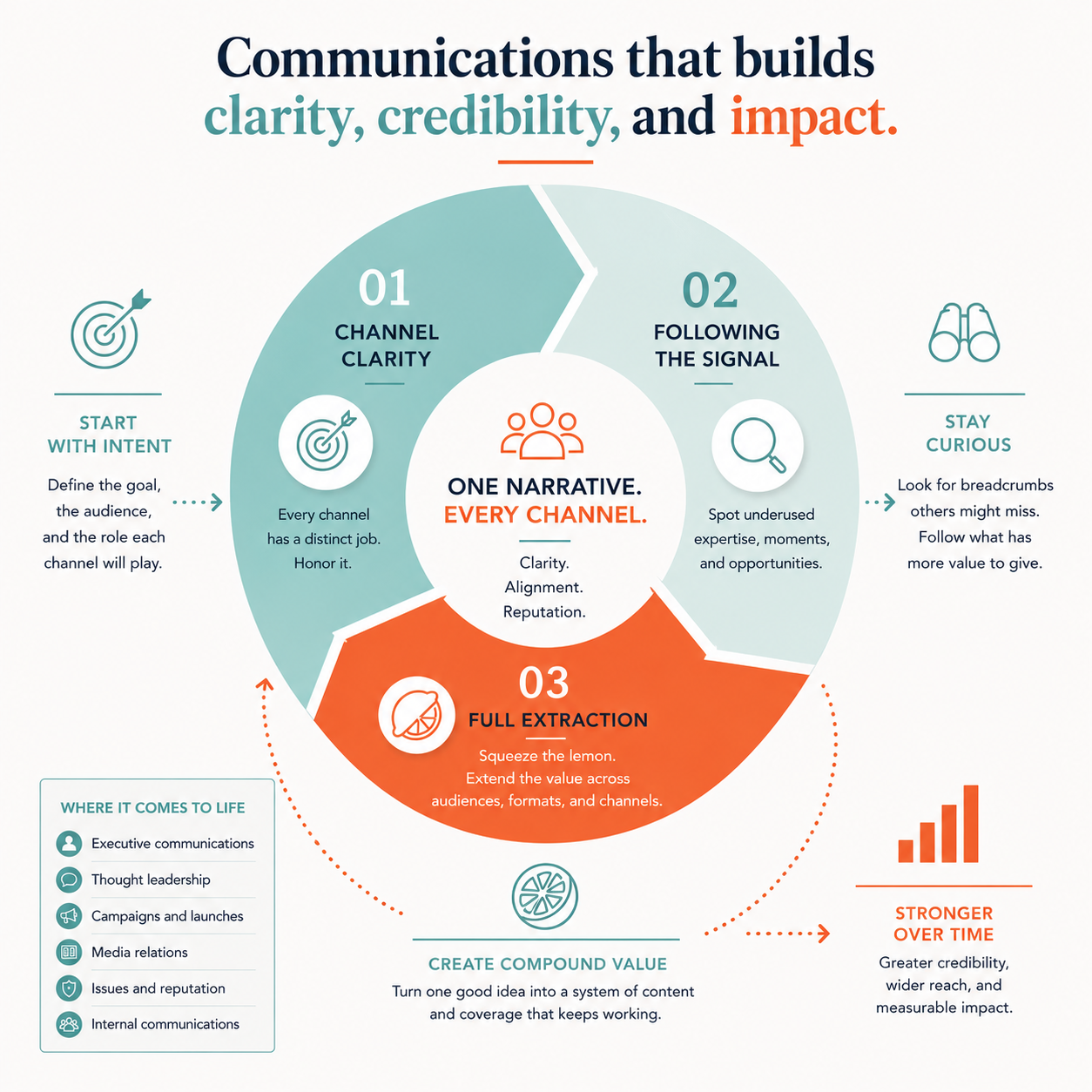
My approach comes down to three moves: channel clarity, following the signal, and full extraction. Together, they shape how I help organizations communicate with clarity, whether the work involves executive communications, thought leadership, media relations, or integrated campaigns. Two examples below show the framework in practice.
Every communications strategy needs its own personality and trajectory, shaped by why it exists and what it's meant to accomplish. I bring rigor to editorial and channel strategy, and genuine appreciation for the art of earning attention in ways that actually matter.
The framework starts with a premise that sounds simple but is harder to execute than it looks: every channel has a distinct job. The highest-leverage skill in communications is understanding that job and having the discipline to honor it, even when cross-pollinating seems obvious.
My role is to shape the strategy, align stakeholders, and oversee execution so every channel plays its intended role in one larger narrative.
01Channel Clarity: Independence vs. Crossover
The first question I ask when building any earned/owned strategy isn't how do these channels connect? It's should they connect at all?
The decision is driven by three things: the nature of the story, the audience each channel is actually reaching, and the specific business goal that tactic is meant to serve.
In practice: RPA healthcare hubWhile at RPA, the agency lost a major healthcare client and needed to demonstrate its healthcare expertise to CMOs at hospital systems and insurance companies. It was a business development challenge as much as a communications one, requiring a strategy that built credibility over time rather than chasing short-term attention.
Working across a matrixed organization, I assembled and led a cross-disciplinary team of strategists, creatives, digital specialists, producers, PR, and media partners, aligning stakeholders from concept through executive approval. Together we built a layered channel strategy anchored by a healthcare hub on rpa.com, with each channel assigned one clear job.
Dark LinkedIn posts were precision instruments pointed at one audience with one goal: get healthcare CMOs to the hub. The copy spoke directly to the marketing problems keeping them up at night, including the nuances of patient trust, the complexity of regulated messaging, and the challenges endemic to healthcare advertising. No broad brand play. One audience, one job.
Organic LinkedIn and Instagram posts had a completely different mandate. They shined a light on the experts behind the paper, the people and their thinking, and spoke to a broader professional audience curious about the agency's point of view. The goal was brand positioning, credibility, and reputation, not prospecting.
A byline published by the Society for Health Care Strategy & Market Development on social media strategy in an era of mistrust stood entirely alone, with no CTA to the hub and no direct link back to the campaign. Its value was precisely its independence. Third-party validation by an organization that healthcare marketers read and trust.
The internal communications layer included intranet banners, screen posters, and a CEO note inviting employees to amplify the campaign. I came to think of internal communications as its own form of earned media. Employees share stories they genuinely believe matter. Through repeated experience I learned that a thoughtful CEO call to action, used selectively rather than routinely, consistently outperformed a standard social post. This campaign earned 45 employee reposts because the internal strategy had been built long before launch.
The hub itself attracted marketers from more than 15 top healthcare organizations that met the agency's criteria for prospecting and became a standing new business asset, referenced in pitches to healthcare and healthcare-adjacent clients long after the initial campaign ran. That's the measure of a channel strategy that did its job: not just a launch moment, but a durable piece of infrastructure.
One important note: the campaign didn't directly generate new healthcare business while it was active. That's a useful reminder that communications can build credibility, visibility, and opportunity, but it can't replace the business development systems needed to convert interest into clients.
“A credential in isolation is a missed opportunity.”
02Following the Signal
The second concept lives in the space between strategy and instinct. It's the ability to spot an opportunity, whether a moment, a person, a placement, or a piece of content, and recognize that there's more there than what's visible on the surface.
I think of it as following breadcrumbs. Not every placement or piece of content is a breadcrumb. A breadcrumb is a signal that something has more value to give if you're willing to pursue it. The skill is recognizing it before the opportunity is obvious.
I've learned the strongest thought leadership comes from people who genuinely want to build their profile, not those who feel obligated to participate. I look for experts with something meaningful to say and a genuine interest in saying it. That combination of expertise and enthusiasm is what makes a platform sustainable instead of performative.
In practice: Amina Asim, PhDI found exactly that in Amina Asim, PhD. Her credentials were unusual for an ad agency environment; a doctorate isn't common advertising. Her expertise in data strategy, programmatic advertising, and the post-cookie landscape was directly relevant to challenges CMOs were navigating in real time. She was also a natural communicator with an interest in building her personal brand. I spotted the breadcrumb: someone with something meaningful to say to an audience that wanted to hear it.
The first move was a speaking opportunity, a featured panel at the MediaPost Data & Programmatic Insider Summit on the return to contextual advertising. One moment that became the foundation for much more.
03Full Extraction: Squeezing the Lemon
A speaking placement is a credential. A credential in isolation is a missed opportunity. That's where I start talking about squeezing the lemon. The real work begins after the appearance, figuring out how many audiences, formats, and channels one good idea can reach before its value is genuinely exhausted.
In practice: extending Amina's authorityFollowing Amina's MediaPost panel, I developed a content strategy and built a sustained content ecosystem, mapping each format and channel against a deliberate editorial calendar.
Original long-form content lived on rpa.com as an article on navigating the evolving ad tech landscape, written in Amina's voice, consistent with the agency's brand voice, and positioned for the marketing leaders.
Social content across LinkedIn and Instagram broke the ideas into digestible form for audiences who wouldn't seek out a long-form article but would engage with a sharp excerpt or a pointed question.
A podcast episode on the primacy of first-party data, a format that invites a different audience into the conversation and lets personality come through in a way the written word can't.
A byline in MediaPost titled "First-Party Data: Your Property, Your Rules," placed with the same publication where she had originally spoken. This was deliberate. She wasn't a one-time panelist anymore. She was a recurring, credible voice in that publication's ecosystem. The loop closed. The authority compounded.
Amina's growing thought leadership profile became a genuine differentiator for the agency in new business conversations, signaling that RPA had the kind of specialized data expertise that clients were increasingly needing. That's what full extraction looks like when it works: one person's genuine expertise extended across formats and audiences until it becomes a tangible business asset.
Every extension came from the same starting point: one person's expertise, one initial opportunity, and the discipline to keep asking, "What else is in here?"
“The skill is recognizing it before the opportunity is obvious.”
04The Through-Line
Together, these examples reflect the same philosophy that's shaped my career: helping organizations communicate with greater clarity by making intentional choices about narrative, audience, and channel.
The healthcare campaign was about channel clarity, understanding the distinct role every channel played and resisting the urge to integrate for integration's sake.
Amina's story was about following the signal, recognizing underused expertise, creating one meaningful opportunity, then squeezing every bit of value from it across audiences and formats.
Whether I'm advising executives, building thought leadership, launching a campaign, or developing an editorial strategy, I come back to the same questions:
Why are we telling this story?
Who actually needs to hear it?
What role should each channel play?
Is there more value here than we're seeing?
There usually is.
The job is staying curious enough to find it, and disciplined enough to know what to do once you do.
“The job is staying curious enough to find it, and disciplined enough to know what to do once you do.”